

The flow editor
The flow editor is a graphical interface in which you arrange states as nodes and link them with connections (transitions). You can arrange the graph freely, add states, edit them, and remove them again.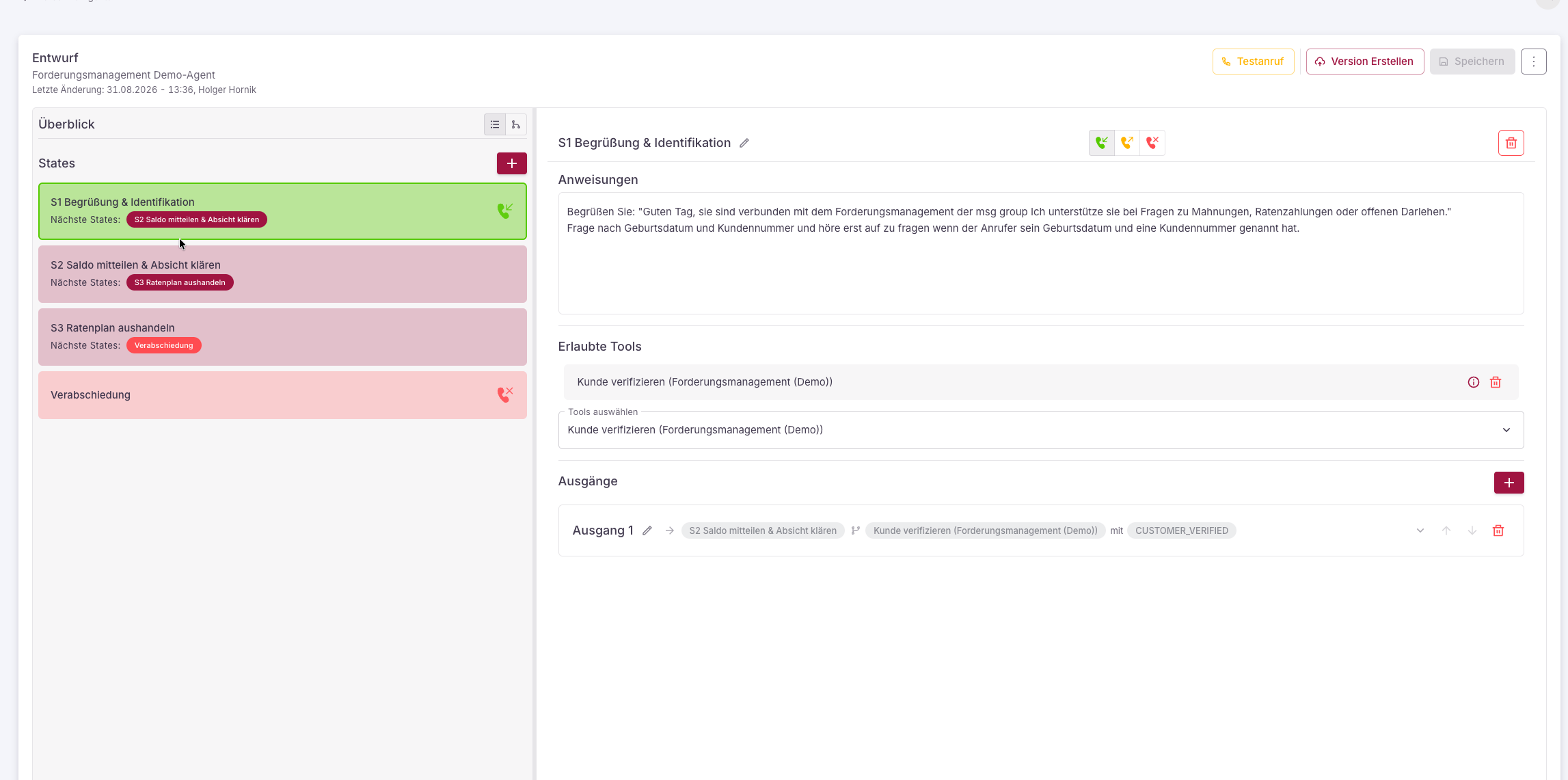
The flow editor: on the left the list of states, on the right the configuration of the selected state (instructions, permitted tools, outputs).
States
A flow consists of states – the steps of the conversation. A state carries its own instructions, permitted tools, and transitions to subsequent states. Two additional points end the conversation:Forwarding
Connects the call to an external phone number (e.g. to a human).
Hanging up
Ends the call.
Transitions and conditions
A state has outputs – named, ordered transitions to subsequent states. Each output is tied to a condition:- a tool that was called in the state,
- an expected response code (the result of the tool),
- optionally negated (“does not apply”).
No response code, no transition. If a tool does not trigger a declared response code, the agent stays in the current state. This keeps you in control of the conversation’s course.
Example
Tools in a state
For each state, you define which tools the agent may use there. They come from three categories (details under Integrations & Tools):- Built-in tools – platform-native and configuration-free, such as
classifyfor sorting the request. The categories become response codes for your transitions. - Connector tools – business actions such as “book appointment” or “look up patient” that go to your system via a connector (e.g. planorg PVS).
- MCP tools – tools of a connected MCP server.
classify, transfer, and hang-up work fully. Connector-tool execution is live for the connected systems (MCP servers, planorg PVS, demo connectors).State instructions
Each state can carry its own instructions that apply only there (in addition to the agent’s base instructions).Validation
The editor checks your flow continuously – for example whether all states are reachable and transitions are valid. Open issues are shown before you publish.Versioning
1
Edit the draft
You always work on an editable draft.
2
Publish
On publishing, the draft is validated and stored as an immutable, numbered version.
3
Activate
You set a version as the live version. New calls use it immediately.
Import and export flows
You can export a complete flow as a JSON file and import it elsewhere – handy for backing up, duplicating, or transferring flows between agents.1
Export
In the flow editor, open the ⋮ menu (top right) and choose Export flow. The current flow is downloaded as a JSON file. Export is also possible in the read-only version view.
2
Import
In the draft, open the same menu and choose Import flow. Pick a previously exported JSON file; its content replaces the current draft. Afterwards, check the result with a test call.
The import overwrites the existing draft. Already published versions remain untouched – the imported flow only becomes a version with the next publish.
Structure of an export file
The file contains aflow object with:
-
startStateId– ID of the start state. -
statesOrder– order of the states. -
states– the states, one key per state ID. A state carries:type–REGULAR,FORWARD, orHANGUP.name– display name.stateInstructions– the instructions of the state.allowedTools– permitted tools (forREGULAR).outputsOrder/outputs– the outputs. Each output has a target (transitionTo) andconditionsmade oftool,responseCode, andisNegated.
FORWARDstate additionally carries the target phone number, aHANGUPstate only a name and instructions.