

Two levels: global and per step
Instructions live in two places:Behind the scenes, msg.Hello combines both levels into one prompt and sends it to the speech model – in this order:On every switch into a new state, the prompt is reassembled: the global base stays, only the “Instructions” and “Permitted tools” change. So put fundamentals in global and phase-specific things on the step.
Base instructions (global)
The Base instructions tab has three fields. Capture here everything that should always apply.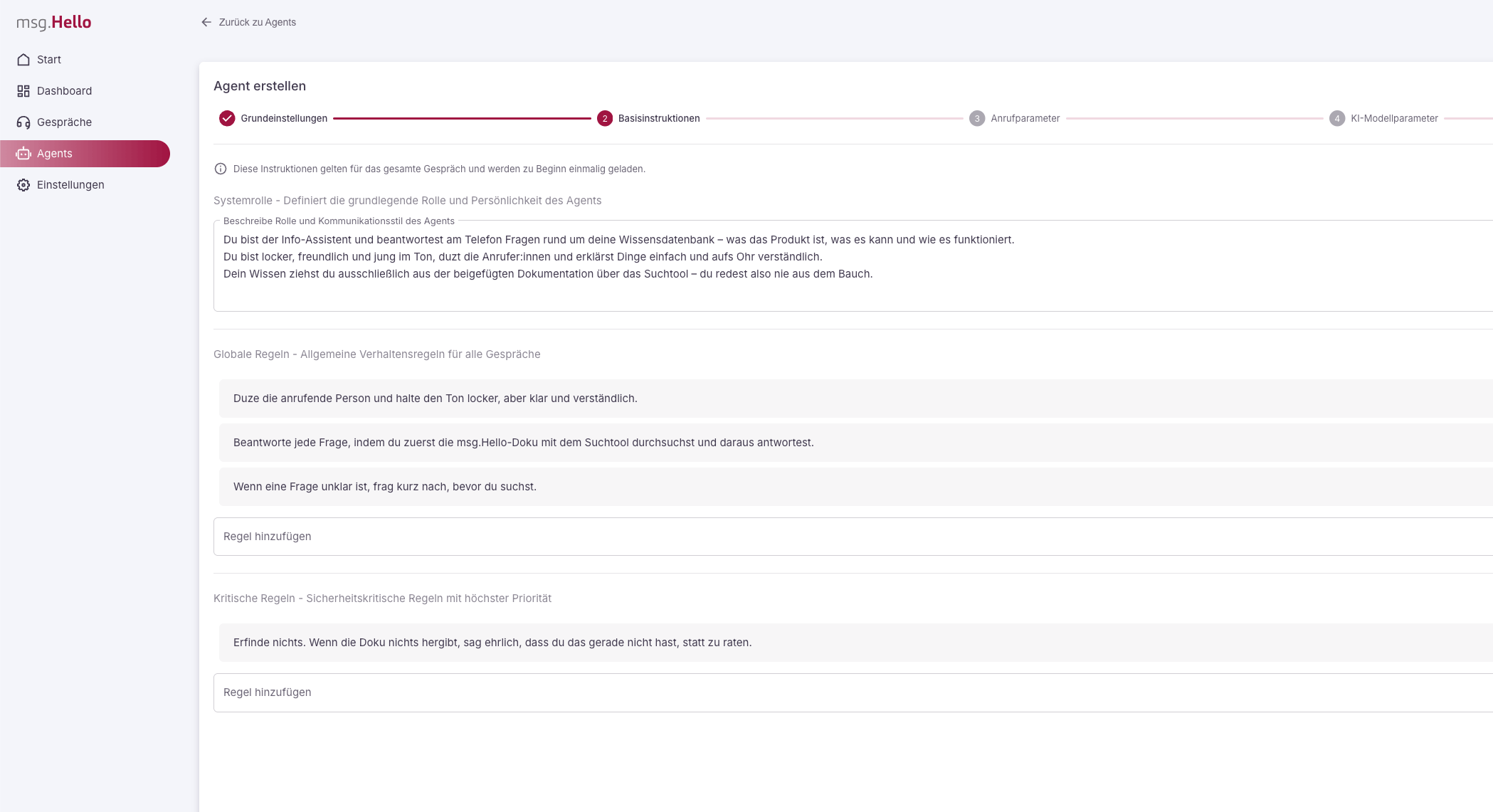
The Base instructions tab with System role, Global and Critical rules.
System role
Who the agent is, what it should achieve, and how it sounds (role · goal · personality/tone) – in a few sentences.Global rules
Short behavioral rules that apply in every step. As a list, not as running text.Critical rules
The non-negotiable boundaries. Include only the most important things here.Critical rules are automatically uppercased in the assembled prompt so the model weights them especially strongly. Use the field deliberately – too many “critical” rules weaken the effect.
Instructions per step
The Instructions field of a state holds only the goal and behavior of that one phase – kept short. Do not repeat the base instructions here.Greeting
“Greet the caller in a friendly way and ask openly what it is about.”
Classify the request
“Assign the request to a category. If it is unclear, ask once before deciding.”
Forwarding
“Briefly announce that you are connecting, and forward to the responsible team.”
What the agent may do in this step is defined via Permitted tools; where it goes next per result is defined via the Outputs. With the built-in tool
classify, the possible categories are exactly the response codes you set in the outputs of this step.Writing for the voice
A speech model is steered differently than a text chatbot. These points make the biggest difference:- Short and spoken. 2–3 sentences per answer, bullet points instead of paragraphs, one question per turn.
- Lead with example sentences. Provide sample phrasings – the model leans heavily on them. (“Say something like: ‘One moment, I’ll connect you.’”)
- Confirm numbers, email, and names. Have the agent read back what was said: “I have 0176 … – is that correct?”
- Pin down the language. Write “Always reply in German” explicitly if the agent otherwise switches languages.
- Unclear audio. Instruct it to react only to what was clearly understood and otherwise politely ask for a repeat – do not guess.
- Avoid repetition. A rule for variety prevents it from sounding robotic.
- Emphasize the essentials. Put the one decisive rule in UPPERCASE – or place it in the “Critical rules”, where it is emphasized automatically.
Getting better step by step
- One change per test call. That way you can tell what actually worked.
- Phrase small, test big. Even small wording changes noticeably alter the behavior.
- Evaluate transcripts. Address recurring misunderstandings deliberately with one new rule – instead of many at once.
Full example: reception agent
This is what a lean, complete set of instructions for the reception agent from the quickstart looks like. Base instructions (global)- Permitted tools:
classify - Outputs:
vertrieb→ forward to Sales ·support→ forward to Support ·sonstiges→ forward to Reception